Lecture 20 - (07/05/2026)
Today’s Topics:
Bayesian Classification
Myer Briggs Analysis
Bayesian Classification
Naive Bayes models are a group of extremely fast and simple classification algorithms that are often suitable for very high-dimensional datasets.
Because they are so fast and have so few tunable parameters, they end up being useful as a quick-and-dirty baseline for a classification problem.
These classifiers depend on Bayes Theorem which lets us model the relationship of conditional probabilities of statistical quantaties.
In Bayesian classification, we’re interested in finding the probability of a label given some observed features, which we can write as .
If we are trying to decide between two labels—let’s call them and —then one way to make this decision is to compute the ratio of the posterior probabilities for each label:
All we need now is some model by which we can compute for each label. Such a model is called a generative model because it specifies the hypothetical random process that generates the data. Specifying this generative model for each label is the main piece of the training of such a Bayesian classifier.
The general version of this straining step is normally very complex, but if we make some key assumptions about the model it can be very simple! We can find a rough approximation of the generative model for each class, and then proceed with the Bayesian classification.
import numpy as np
import matplotlib.pyplot as plt
import seaborn as sns
Gaussian Naive Bayes
Perhaps the easiest naive Bayes classifier to understand is Gaussian naive Bayes. With this classifier, the assumption is that data from each label is drawn from a simple Gaussian distribution. Imagine that we have the following data:
from sklearn.datasets import make_blobs
X, y = make_blobs(100, 2, centers=2, random_state=2, cluster_std=1.5)
plt.scatter(X[:, 0], X[:, 1], c=y, s=50, cmap='RdBu');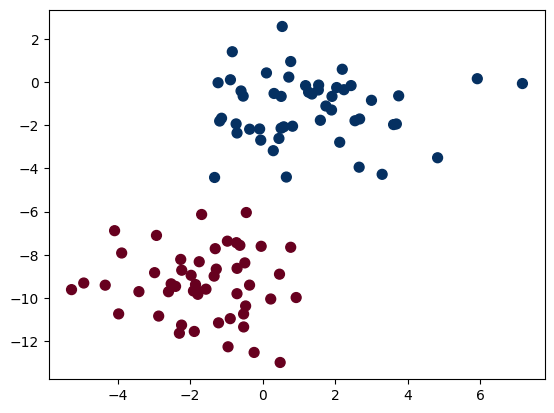
The simplest Gaussian model is to assume that the data is described by a Gaussian distribution with no covariance between dimensions. This model can be fit by computing the mean and standard deviation of the points within each label, which is all we need to define such a distribution. The result of this naive Gaussian assumption is:
Source
import numpy as np
import matplotlib.pyplot as plt
from sklearn.datasets import make_blobs
from sklearn.naive_bayes import GaussianNB
from matplotlib.patches import Ellipse

# Generate data
X, y = make_blobs(
    n_samples=100,
    n_features=2,
    centers=2,
    random_state=2,
    cluster_std=1.5
)

# Fit Gaussian Naive Bayes
model = GaussianNB()
model.fit(X, y)

# Plot points
plt.figure(figsize=(8, 6))
plt.scatter(X[:, 0], X[:, 1], c=y, s=50, cmap='RdBu')

# Draw Gaussian ellipses
colors = ['red', 'blue']

for i, color in enumerate(colors):
    mean = model.theta_[i]          # class mean
    var = model.var_[i]             # class variance (diagonal covariance)

    # Width and height from variance
    width = 2 * np.sqrt(var[0]) * 2
    height = 2 * np.sqrt(var[1]) * 2

    ellipse = Ellipse(
        xy=mean,
        width=width,
        height=height,
        angle=0,                    # Naive Bayes assumes no covariance
        edgecolor=color,
        facecolor='none',
        linewidth=3
    )

    plt.gca().add_patch(ellipse)

    # Mark class center
    plt.scatter(mean[0], mean[1], c=color, s=200, marker='x')

plt.title("Gaussian Naive Bayes")
plt.xlabel("Feature 1")
plt.ylabel("Feature 2")
plt.axis('equal')
plt.show()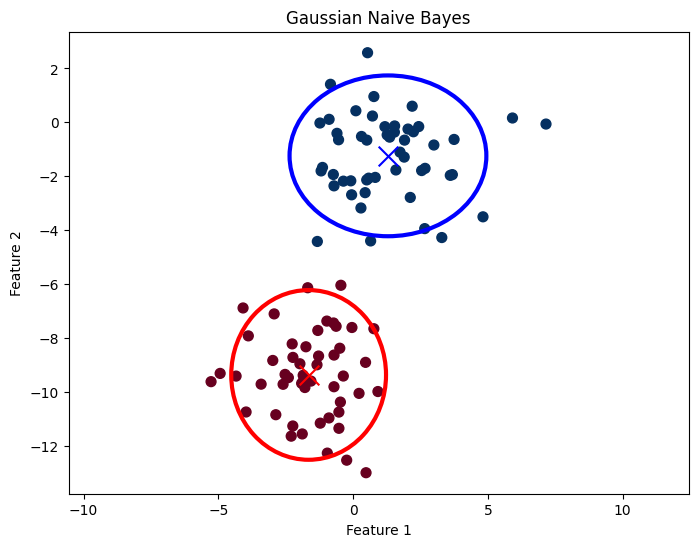
The ellipses here represent the Gaussian generative model for each label, with larger probability toward the center of the ellipses. With this generative model in place for each class, we have a simple recipe to compute the likelihood for any data point, and thus we can quickly compute the posterior ratio and determine which label is the most probable for a given point.
This procedure is implemented in Scikit-Learn’s sklearn.naive_bayes.GaussianNB estimator:
from sklearn.naive_bayes import GaussianNB
model = GaussianNB()
model.fit(X, y);
Let’s generate some new data and predict the label:
rng = np.random.RandomState(0)
Xnew = [-6, -14] + [14, 18] * rng.rand(2000, 2)
ynew = model.predict(Xnew)
Now we can plot this new data to get an idea of where the decision boundary is (see the following figure):
plt.scatter(X[:, 0], X[:, 1], c=y, s=50, cmap='RdBu')
lim = plt.axis()
plt.scatter(Xnew[:, 0], Xnew[:, 1], c=ynew, s=20, cmap='RdBu', alpha=0.1)
plt.axis(lim);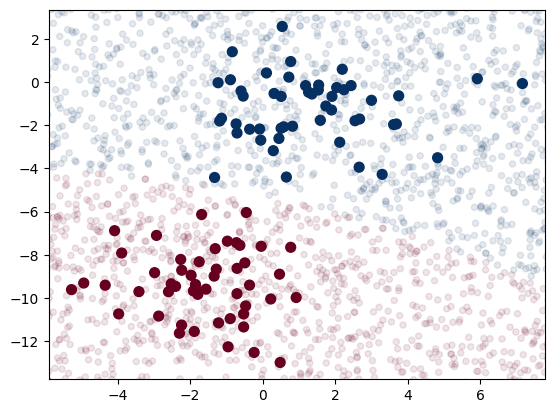
A nice aspect of this Bayesian formalism is that it naturally allows for probabilistic classification, which we can compute using the predict_proba method:
yprob = model.predict_proba(Xnew)
yprob[-8:].round(2)
array([[0.89, 0.11],
[1. , 0. ],
[1. , 0. ],
[1. , 0. ],
[1. , 0. ],
[1. , 0. ],
[0. , 1. ],
[0.15, 0.85]])The columns give the posterior probabilities of the first and second labels, respectively. If you are looking for estimates of uncertainty in your classification, Bayesian approaches like this can be a good place to start.
Of course, the final classification will only be as good as the model assumptions that lead to it, which is why Gaussian naive Bayes often does not produce very good results. Still, in many cases—especially as the number of features becomes large—this assumption is not detrimental enough to prevent Gaussian naive Bayes from being a reliable method.
Multinomial Naive Bayes
The Gaussian assumption just described is by no means the only simple assumption that could be used to specify the generative distribution for each label. Another useful example is multinomial naive Bayes, where the features are assumed to be generated from a simple multinomial distribution. The multinomial distribution describes the probability of observing counts among a number of categories, and thus multinomial naive Bayes is most appropriate for features that represent counts or count rates.
The idea is precisely the same as before, except that instead of modeling the data distribution with the best-fit Gaussian, we model it with a best-fit multinomial distribution.
One place where multinomial naive Bayes is often used is in text classification, where the features are related to word counts or frequencies within the documents to be classified.
Let’s download the data and take a look at the target names:
from sklearn.datasets import fetch_20newsgroups

data = fetch_20newsgroups()
data.target_names
['alt.atheism',
'comp.graphics',
'comp.os.ms-windows.misc',
'comp.sys.ibm.pc.hardware',
'comp.sys.mac.hardware',
'comp.windows.x',
'misc.forsale',
'rec.autos',
'rec.motorcycles',
'rec.sport.baseball',
'rec.sport.hockey',
'sci.crypt',
'sci.electronics',
'sci.med',
'sci.space',
'soc.religion.christian',
'talk.politics.guns',
'talk.politics.mideast',
'talk.politics.misc',
'talk.religion.misc']For simplicity here, we will select just a few of these categories and download the training and testing sets:
categories = ['talk.religion.misc', 'soc.religion.christian',
              'sci.space', 'comp.graphics']
train = fetch_20newsgroups(subset='train', categories=categories)
test = fetch_20newsgroups(subset='test', categories=categories)
Here is a representative entry from the data:
print(train.data[5][48:])Subject: Federal Hearing
Originator: dmcgee@uluhe
Organization: School of Ocean and Earth Science and Technology
Distribution: usa
Lines: 10
Fact or rumor....? Madalyn Murray O'Hare an atheist who eliminated the
use of the bible reading and prayer in public schools 15 years ago is now
going to appear before the FCC with a petition to stop the reading of the
Gospel on the airways of America. And she is also campaigning to remove
Christmas programs, songs, etc from the public schools. If it is true
then mail to Federal Communications Commission 1919 H Street Washington DC
20054 expressing your opposition to her request. Reference Petition number
2493.
In order to use this data for machine learning, we need to be able to convert the content of each string into a vector of numbers.
For this we will use the TF-IDF vectorizer and create a pipeline that attaches it to a multinomial naive Bayes classifier:
from sklearn.feature_extraction.text import TfidfVectorizer
from sklearn.naive_bayes import MultinomialNB
from sklearn.pipeline import make_pipeline

model = make_pipeline(TfidfVectorizer(), MultinomialNB())
With this pipeline, we can apply the model to the training data and predict labels for the test data:
model.fit(train.data, train.target)
labels = model.predict(test.data)
Now that we have predicted the labels for the test data, we can evaluate them to learn about the performance of the estimator. For example, let’s take a look at the confusion matrix between the true and predicted labels for the test data (see the following figure):
from sklearn.metrics import confusion_matrix
mat = confusion_matrix(test.target, labels)
sns.heatmap(mat.T, square=True, annot=True, fmt='d', cbar=False,
            xticklabels=train.target_names, yticklabels=train.target_names,
            cmap='Blues')
plt.xlabel('true label')
plt.ylabel('predicted label');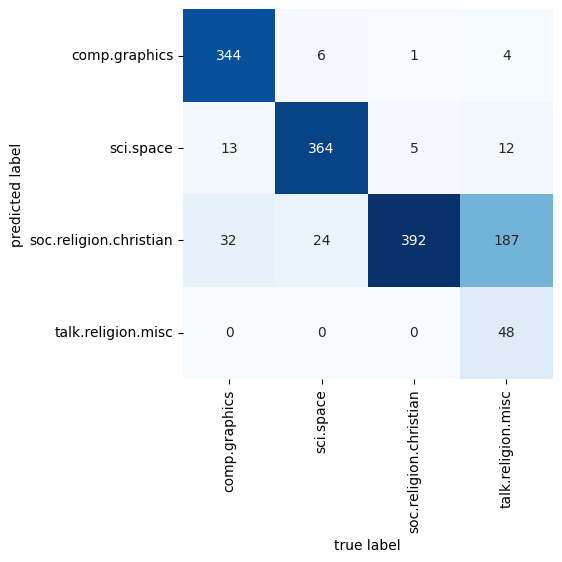
Evidently, even this very simple classifier can successfully separate space discussions from computer discussions, but it gets confused between discussions about religion and discussions about Christianity. This is perhaps to be expected!
The cool thing here is that we now have the tools to determine the category for any string, using the predict method of this pipeline.
Here’s a utility function that will return the prediction for a single string:
def predict_category(s, train=train, model=model):
    pred = model.predict([s])
    return train.target_names[pred[0]]
Let’s try it out:
predict_category('sending a payload to the ISS')'sci.space'predict_category('discussing the existence of God')'soc.religion.christian'predict_category('determining the screen resolution')'comp.graphics'Remember that this is nothing more sophisticated than a simple probability model for the (weighted) frequency of each word in the string; nevertheless, the result is striking. Even a very naive algorithm, when used carefully and trained on a large set of high-dimensional data, can be surprisingly effective.
When to Use Naive Bayes
Because naive Bayes classifiers make such stringent assumptions about data, they will generally not perform as well as more complicated models. That said, they have several advantages:
They are fast for both training and prediction.
They provide straightforward probabilistic prediction.
They are often easily interpretable.
They have few (if any) tunable parameters.
These advantages mean a naive Bayes classifier is often a good choice as an initial baseline classification. If it performs suitably, then congratulations: you have a very fast, very interpretable classifier for your problem. If it does not perform well, then you can begin exploring more sophisticated models, with some baseline knowledge of how well they should perform.
Naive Bayes classifiers tend to perform especially well in the following situations:
When the naive assumptions actually match the data (very rare in practice)
For very well-separated categories, when model complexity is less important
For very high-dimensional data, when model complexity is less important
The last two points seem distinct, but they actually are related: as the dimensionality of a dataset grows, it is much less likely for any two points to be found close together (after all, they must be close in every single dimension to be close overall). This means that clusters in high dimensions tend to be more separated, on average, than clusters in low dimensions, assuming the new dimensions actually add information. For this reason, simplistic classifiers like the ones discussed here tend to work as well or better than more complicated classifiers as the dimensionality grows: once you have enough data, even a simple model can be very powerful.
Myer Briggs Analysis
With Native Bayes down, let’s try to use it!
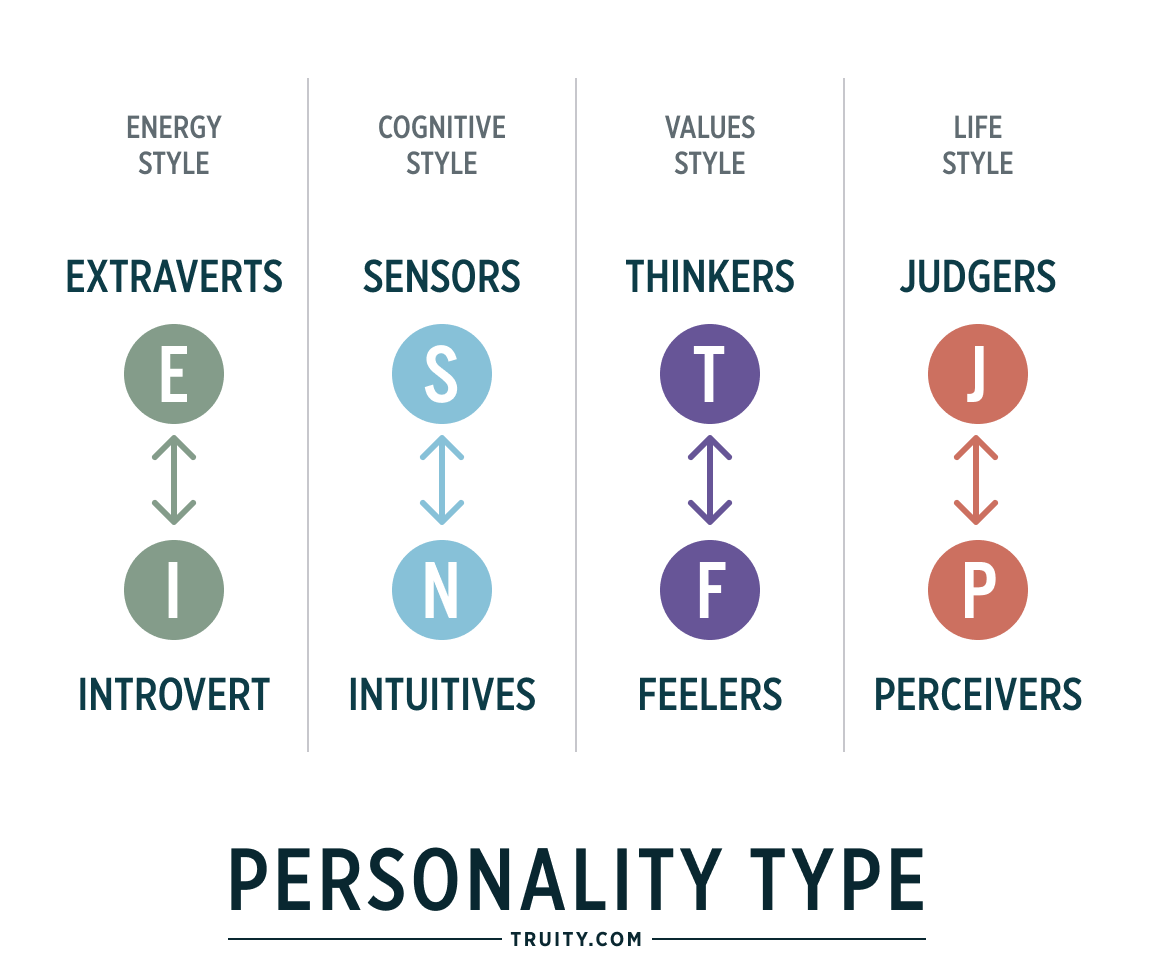
The Myers Briggs Type Indicator (or MBTI for short) is a personality type system that divides everyone into 16 distinct personality types across 4 axis:
Introversion (I) – Extroversion (E)
Intuition (N) – Sensing (S)
Thinking (T) – Feeling (F)
Judging (J) – Perceiving (P)
So for example, someone who prefers introversion, intuition, thinking and perceiving would be labelled an INTP in the MBTI system, and there are lots of personality based components that would model or describe this person’s preferences or behaviour based on the label.
It is one of, if not the, the most popular personality test in the world. It is used in businesses, online, for fun, for research and lots more. A simple google search reveals all of the different ways the test has been used over time. It’s safe to say that this test is still very relevant in the world in terms of its use.
Let’s use Native Bayes to make a classifier for MBTI Personality Types using this data
Source
import pandas as pd
from sklearn.tree import DecisionTreeClassifier
from sklearn.metrics import classification_report
from sklearn.linear_model import LogisticRegression
from sklearn.preprocessing import LabelEncoder
from sklearn.feature_extraction.text import TfidfVectorizer
from wordcloud import WordCloud
from tqdm import tqdm
import nltk
from nltk.stem import WordNetLemmatizer
from nltk.corpus import stopwords
import re
from sklearn.model_selection import train_test_split
from sklearn.svm import SVC,LinearSVC
from sklearn.ensemble import RandomForestClassifier,GradientBoostingClassifier
import matplotlib.pyplot as plt
import seaborn as sns
from sklearn.metrics import accuracy_score
from sklearn.naive_bayes import MultinomialNB
from sklearn.experimental import enable_hist_gradient_boosting
from sklearn.ensemble import HistGradientBoostingClassifier
import plotly.express as px
from pprint import pprint
import warnings
warnings.filterwarnings('ignore')
data=pd.read_csv('mbti_1.csv')
data.head()data['type'].value_counts()type
INFP 1832
INFJ 1470
INTP 1304
INTJ 1091
ENTP 685
ENFP 675
ISTP 337
ISFP 271
ENTJ 231
ISTJ 205
ENFJ 190
ISFJ 166
ESTP 89
ESFP 48
ESFJ 42
ESTJ 39
Name: count, dtype: int64data.info()<class 'pandas.DataFrame'>
RangeIndex: 8675 entries, 0 to 8674
Data columns (total 2 columns):
# Column Non-Null Count Dtype
--- ------ -------------- -----
0 type 8675 non-null str
1 posts 8675 non-null str
dtypes: str(2)
memory usage: 135.7 KB
pprint(data.posts[0])("'http://www.youtube.com/watch?v=qsXHcwe3krw|||http://41.media.tumblr.com/tumblr_lfouy03PMA1qa1rooo1_500.jpg|||enfp "
'and intj moments https://www.youtube.com/watch?v=iz7lE1g4XM4 sportscenter '
'not top ten plays https://www.youtube.com/watch?v=uCdfze1etec '
'pranks|||What has been the most life-changing experience in your '
'life?|||http://www.youtube.com/watch?v=vXZeYwwRDw8 '
'http://www.youtube.com/watch?v=u8ejam5DP3E On repeat for most of '
'today.|||May the PerC Experience immerse you.|||The last thing my INFJ '
'friend posted on his facebook before committing suicide the next day. Rest '
'in peace~ http://vimeo.com/22842206|||Hello ENFJ7. Sorry to hear of your '
"distress. It's only natural for a relationship to not be perfection all the "
'time in every moment of existence. Try to figure the hard times as times of '
'growth, as...|||84389 84390 '
'http://wallpaperpassion.com/upload/23700/friendship-boy-and-girl-wallpaper.jpg '
'http://assets.dornob.com/wp-content/uploads/2010/04/round-home-design.jpg '
'...|||Welcome and '
'stuff.|||http://playeressence.com/wp-content/uploads/2013/08/RED-red-the-pokemon-master-32560474-450-338.jpg '
'Game. Set. Match.|||Prozac, wellbrutin, at least thirty minutes of moving '
"your legs (and I don't mean moving them while sitting in your same desk "
'chair), weed in moderation (maybe try edibles as a healthier '
"alternative...|||Basically come up with three items you've determined that "
'each type (or whichever types you want to do) would more than likely use, '
"given each types' cognitive functions and whatnot, when left by...|||All "
'things in moderation. Sims is indeed a video game, and a good one at that. '
'Note: a good one at that is somewhat subjective in that I am not completely '
'promoting the death of any given Sim...|||Dear ENFP: What were your '
'favorite video games growing up and what are your now, current favorite '
'video games? :cool:|||https://www.youtube.com/watch?v=QyPqT8umzmY|||It '
"appears to be too late. :sad:|||There's someone out there for "
'everyone.|||Wait... I thought confidence was a good thing.|||I just cherish '
'the time of solitude b/c i revel within my inner world more whereas most '
"other time i'd be workin... just enjoy the me time while you can. Don't "
"worry, people will always be around to...|||Yo entp ladies... if you're into "
'a complimentary personality,well, hey.|||... when your main social outlet is '
'xbox live conversations and even then you verbally fatigue '
'quickly.|||http://www.youtube.com/watch?v=gDhy7rdfm14 I really dig the part '
'from 1:46 to 2:50|||http://www.youtube.com/watch?v=msqXffgh7b8|||Banned '
'because this thread requires it of me.|||Get high in backyard, roast and eat '
'marshmellows in backyard while conversing over something intellectual, '
'followed by massages and '
'kisses.|||http://www.youtube.com/watch?v=Mw7eoU3BMbE|||http://www.youtube.com/watch?v=4V2uYORhQOk|||http://www.youtube.com/watch?v=SlVmgFQQ0TI|||Banned '
"for too many b's in that sentence. How could you! Think of the B!|||Banned "
'for watching movies in the corner with the dunces.|||Banned because Health '
'class clearly taught you nothing about peer pressure.|||Banned for a whole '
'host of reasons!|||http://www.youtube.com/watch?v=IRcrv41hgz4|||1) Two baby '
'deer on left and right munching on a beetle in the middle. 2) Using their '
"own blood, two cavemen diary today's latest happenings on their designated "
'cave diary wall. 3) I see it as...|||a pokemon world an infj society '
'everyone becomes an '
'optimist|||49142|||http://www.youtube.com/watch?v=ZRCEq_JFeFM|||http://discovermagazine.com/2012/jul-aug/20-things-you-didnt-know-about-deserts/desert.jpg|||http://oyster.ignimgs.com/mediawiki/apis.ign.com/pokemon-silver-version/d/dd/Ditto.gif|||http://www.serebii.net/potw-dp/Scizor.jpg|||Not '
"all artists are artists because they draw. It's the idea that counts in "
'forming something of your own... like a signature.|||Welcome to the robot '
"ranks, person who downed my self-esteem cuz I'm not an avid signature artist "
'like herself. :proud:|||Banned for taking all the room under my bed. Ya '
'gotta learn to share with the '
'roaches.|||http://www.youtube.com/watch?v=w8IgImn57aQ|||Banned for being too '
'much of a thundering, grumbling kind of storm... yep.|||Ahh... old high '
"school music I haven't heard in ages. "
'http://www.youtube.com/watch?v=dcCRUPCdB1w|||I failed a public speaking '
"class a few years ago and I've sort of learned what I could do better were I "
'to be in that position again. A big part of my failure was just overloading '
"myself with too...|||I like this person's mentality. He's a confirmed INTJ "
'by the way. http://www.youtube.com/watch?v=hGKLI-GEc6M|||Move to the Denver '
"area and start a new life for myself.'")
From above it is quite evident that there are many links in the text data. That needed to be removed.
train_data,test_data=train_test_split(data,test_size=0.2,random_state=42,stratify=data.type)def clear_text(data):
data_length=[]
lemmatizer=WordNetLemmatizer()
cleaned_text=[]
for sentence in tqdm(data.posts):
sentence=sentence.lower()
# removing links from text data
sentence=re.sub('https?://[^\s<>"]+|www\.[^\s<>"]+',' ',sentence)
# removing other symbols
sentence=re.sub('[^0-9a-z]',' ',sentence)
data_length.append(len(sentence.split()))
cleaned_text.append(sentence)
return cleaned_text,data_lengthtrain_data.posts,train_length=clear_text(train_data)100%|██████████| 6940/6940 [00:03<00:00, 1985.77it/s]
test_data.posts,test_length=clear_text(test_data)100%|██████████| 1735/1735 [00:00<00:00, 2021.57it/s]
plt.figure(figsize=(15,10))
sns.distplot(train_length,label='train data word length')
sns.distplot(test_length,label='test data word length')
plt.title('Number of words in text',fontdict={'size':20,'style':'italic'})
plt.show()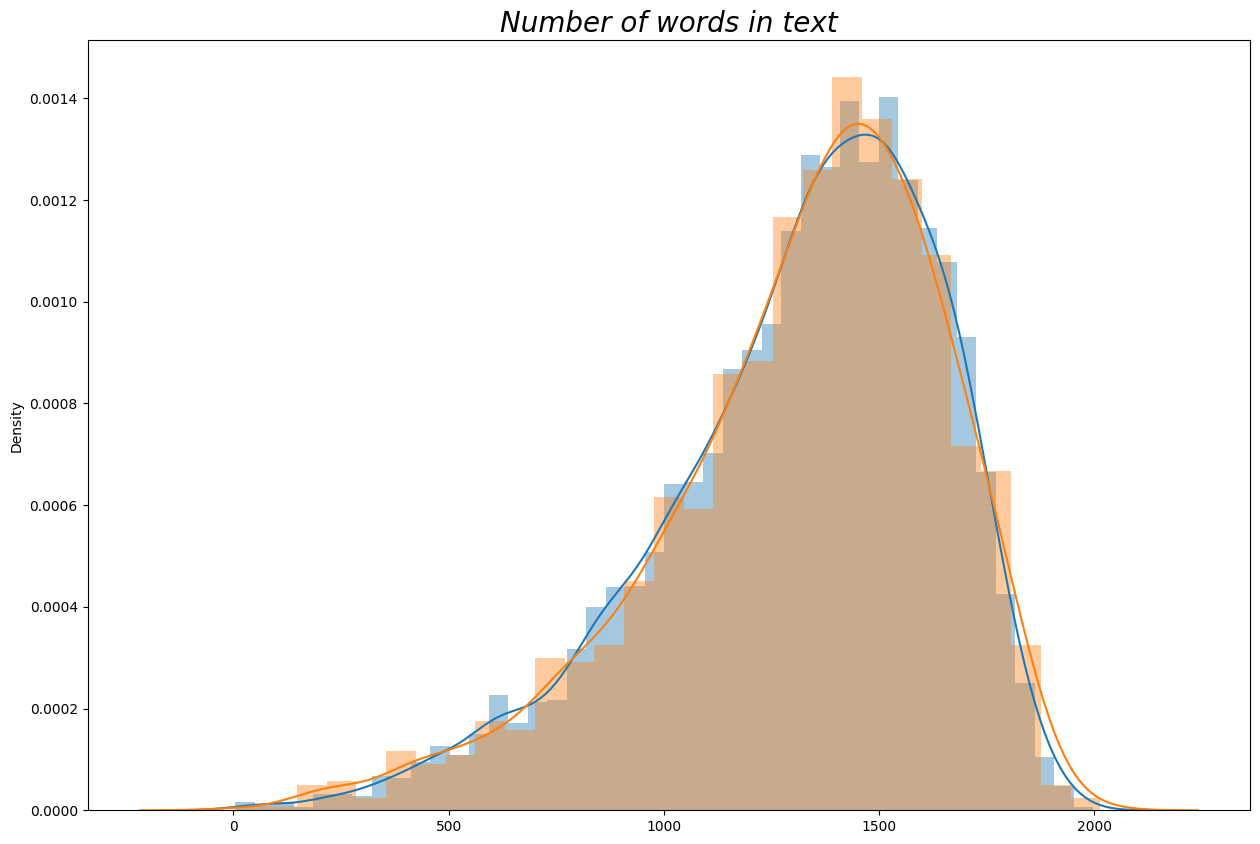
px.pie(train_data,names='type',title='Personality type',hole=0.3)from nltk.corpus import stopwords
from nltk.stem import WordNetLemmatizer
stop_words = set(stopwords.words('english'))
lemmatizer = WordNetLemmatizer()
class Lemmatizer:
def __call__(self, doc):
words = doc.lower().split()
words = [
lemmatizer.lemmatize(word)
for word in words
if word.isalpha() and word not in stop_words
]
return wordsvectorizer=TfidfVectorizer( max_features=5000,tokenizer=Lemmatizer())
vectorizer.fit(train_data.posts)feature_names=vectorizer.get_feature_names_out()
wc=WordCloud(max_words=400)
wc.generate(' '.join(word for word in feature_names[500:3500] ))
plt.figure(figsize=(20,15))
plt.axis('off')
plt.imshow(wc)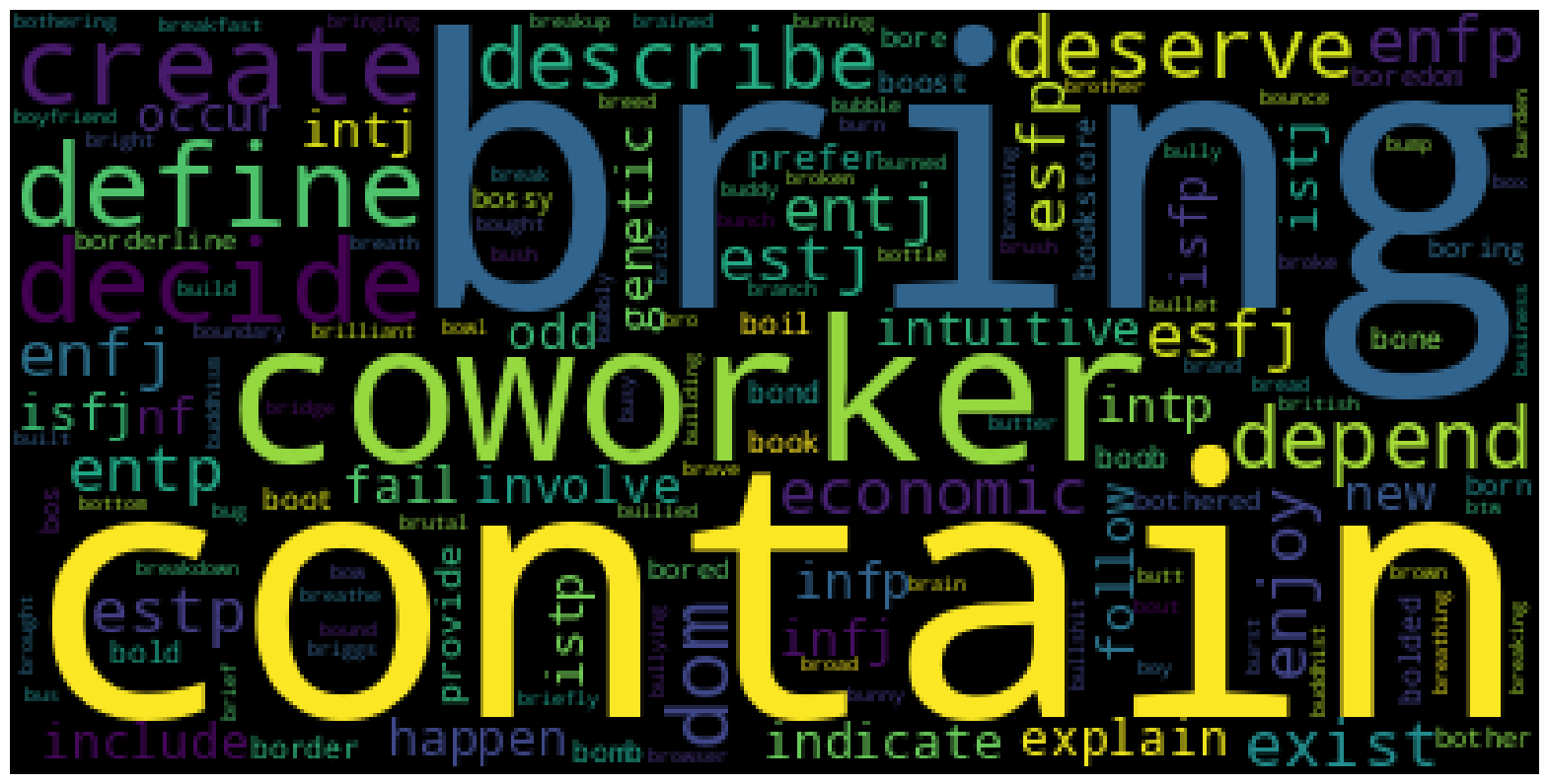
train_post=vectorizer.transform(train_data.posts).toarray()
test_post=vectorizer.transform(test_data.posts).toarray()

target_encoder=LabelEncoder()
models_accuracy={}

train_target=target_encoder.fit_transform(train_data.type)
test_target=target_encoder.fit_transform(test_data.type)
model_multinomial_nb=MultinomialNB()
model_multinomial_nb.fit(train_post,train_target)print('train classification report \n ',classification_report(train_target,model_multinomial_nb.predict(train_post),target_names=target_encoder.inverse_transform([i for i in range(16)])))
print('test classification report \n ',classification_report(test_target,model_multinomial_nb.predict(test_post),target_names=target_encoder.inverse_transform([i for i in range(16)])))train classification report
precision recall f1-score support
ENFJ 0.00 0.00 0.00 152
ENFP 1.00 0.01 0.03 540
ENTJ 0.00 0.00 0.00 185
ENTP 0.92 0.04 0.08 548
ESFJ 0.00 0.00 0.00 33
ESFP 0.00 0.00 0.00 38
ESTJ 0.00 0.00 0.00 31
ESTP 0.00 0.00 0.00 71
INFJ 0.50 0.61 0.55 1176
INFP 0.35 0.94 0.51 1466
INTJ 0.78 0.40 0.53 873
INTP 0.59 0.63 0.61 1043
ISFJ 0.00 0.00 0.00 133
ISFP 0.00 0.00 0.00 217
ISTJ 0.00 0.00 0.00 164
ISTP 1.00 0.00 0.01 270
accuracy 0.45 6940
macro avg 0.32 0.16 0.14 6940
weighted avg 0.54 0.45 0.37 6940
test classification report
precision recall f1-score support
ENFJ 0.00 0.00 0.00 38
ENFP 1.00 0.01 0.01 135
ENTJ 0.00 0.00 0.00 46
ENTP 0.33 0.01 0.01 137
ESFJ 0.00 0.00 0.00 9
ESFP 0.00 0.00 0.00 10
ESTJ 0.00 0.00 0.00 8
ESTP 0.00 0.00 0.00 18
INFJ 0.36 0.42 0.39 294
INFP 0.31 0.91 0.47 366
INTJ 0.73 0.20 0.32 218
INTP 0.52 0.54 0.53 261
ISFJ 0.00 0.00 0.00 33
ISFP 0.00 0.00 0.00 54
ISTJ 0.00 0.00 0.00 41
ISTP 0.00 0.00 0.00 67
accuracy 0.37 1735
macro avg 0.20 0.13 0.11 1735
weighted avg 0.40 0.37 0.29 1735
models_accuracy['Multinomial Naive Bayes']=accuracy_score(test_target,model_multinomial_nb.predict(test_post))from wordcloud import WordCloud, STOPWORDS
import matplotlib.pyplot as plt
stop_words = set(STOPWORDS)
stop_words.update([
'think', 'people', 'know', 'one', 'thing', 'really'
])
types = data.type.unique()
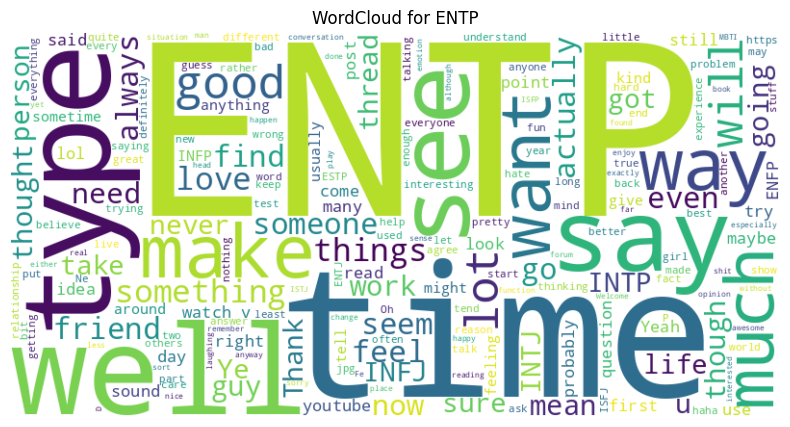
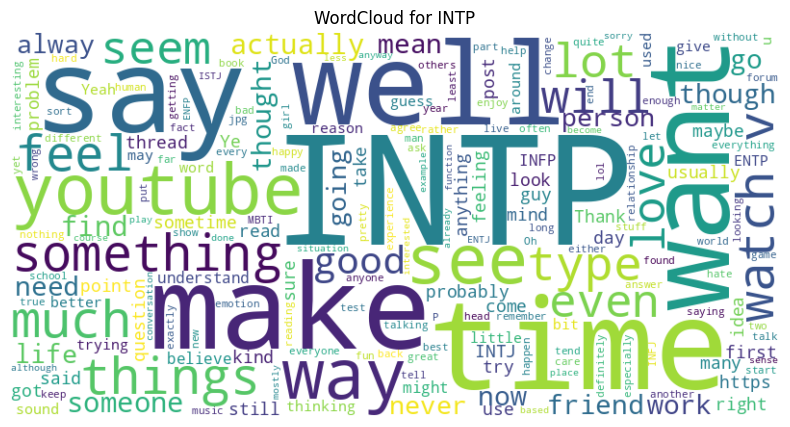
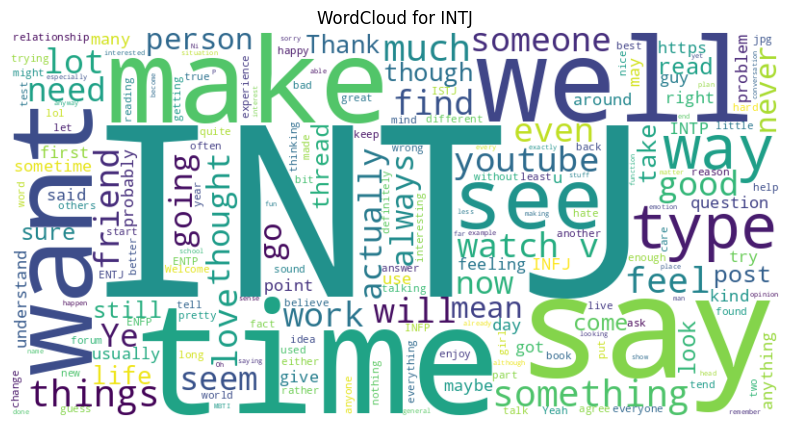
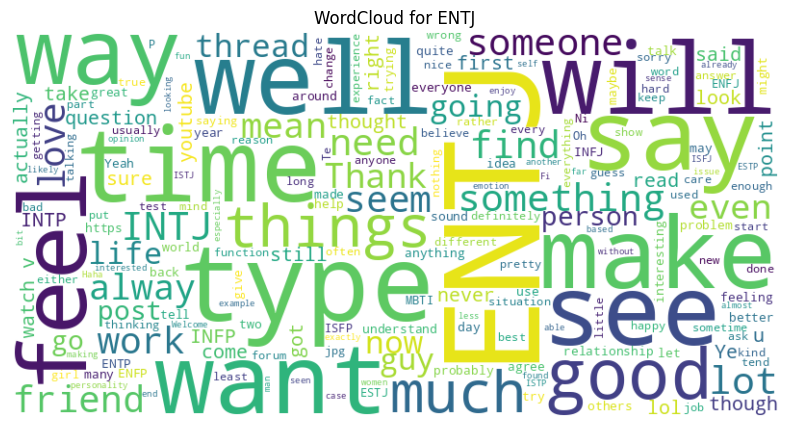
for t in types:
text = " ".join(data[data.type == t].posts)
wc = WordCloud(
width=800,
height=400,
background_color='white',
stopwords=stop_words
).generate(text)
plt.figure(figsize=(10,5))
plt.imshow(wc, interpolation='bilinear')
plt.axis('off')
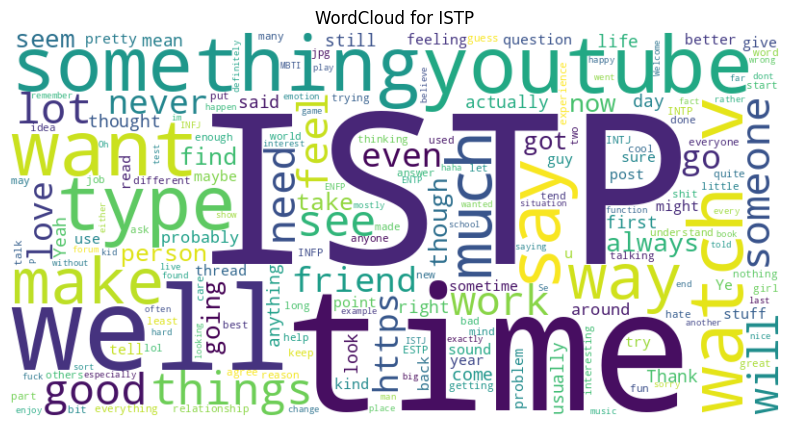
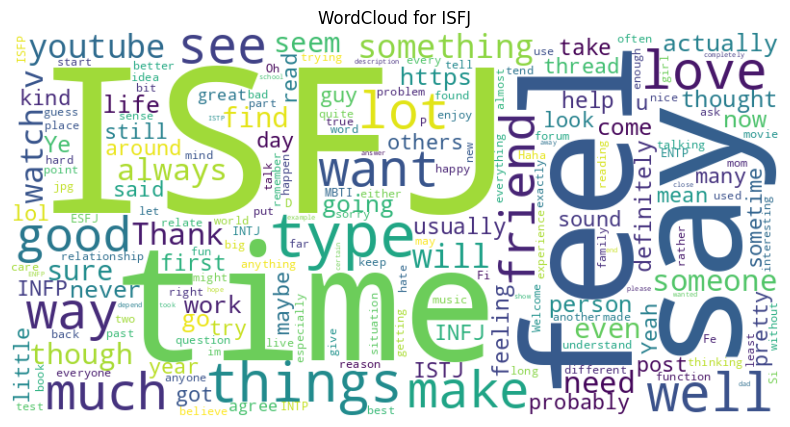
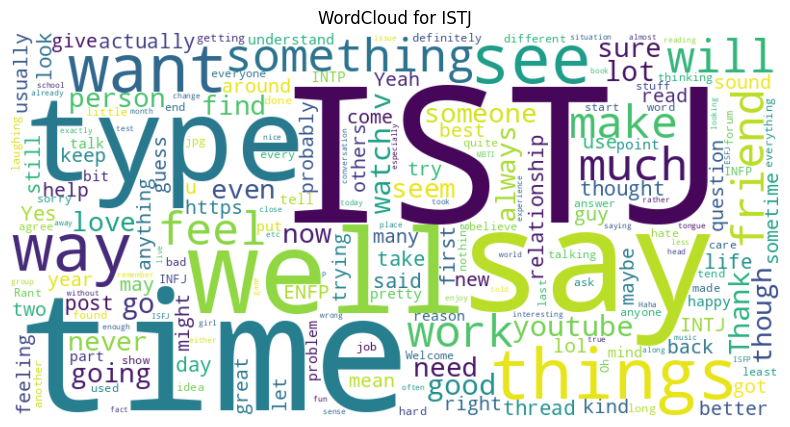
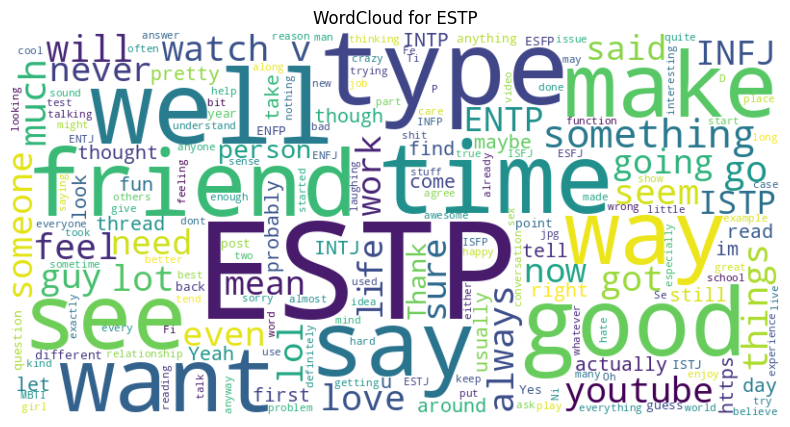
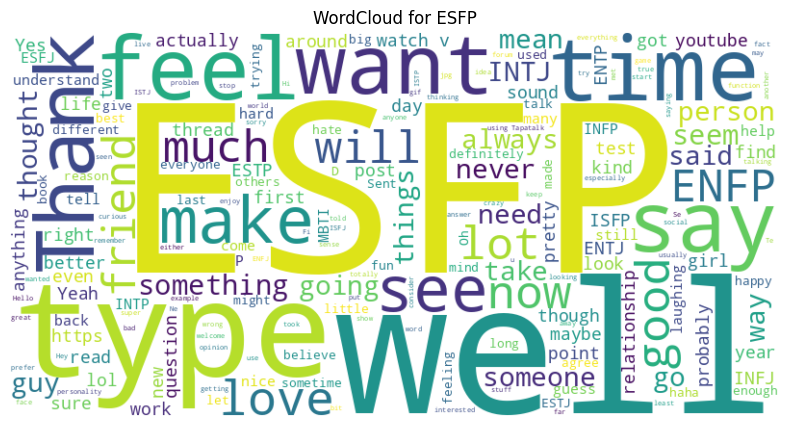
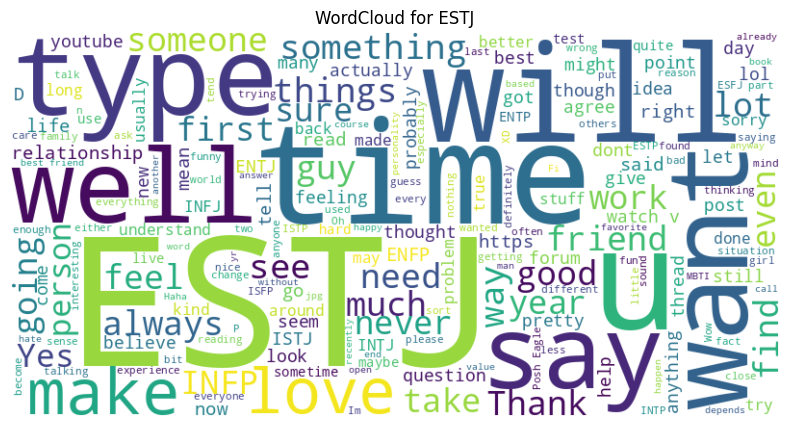
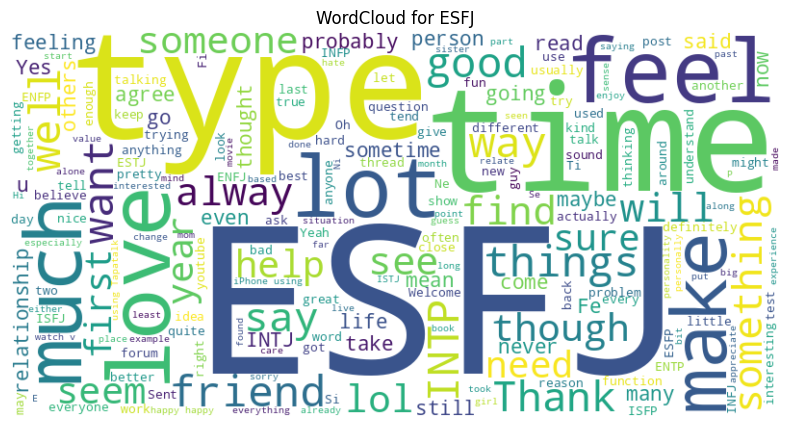
plt.title(f"WordCloud for {t}")
plt.show()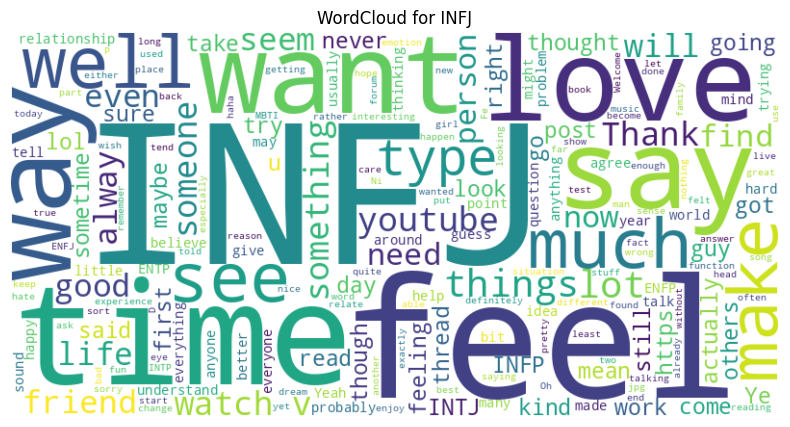
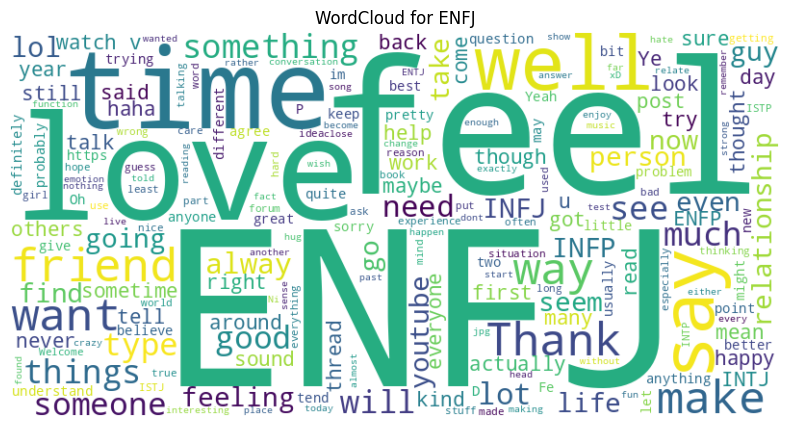
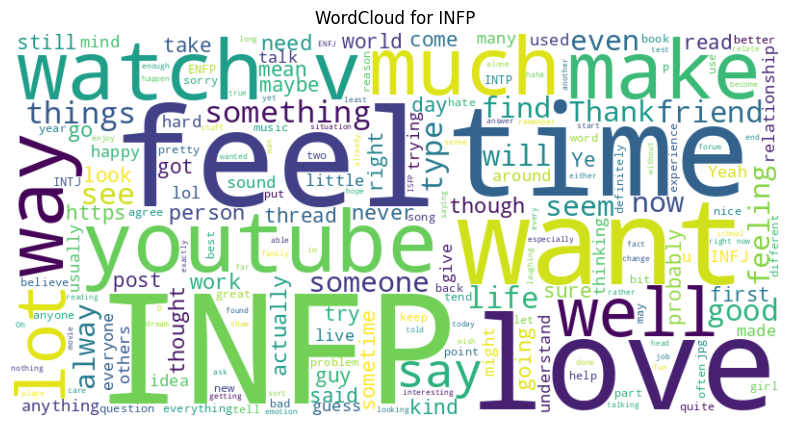
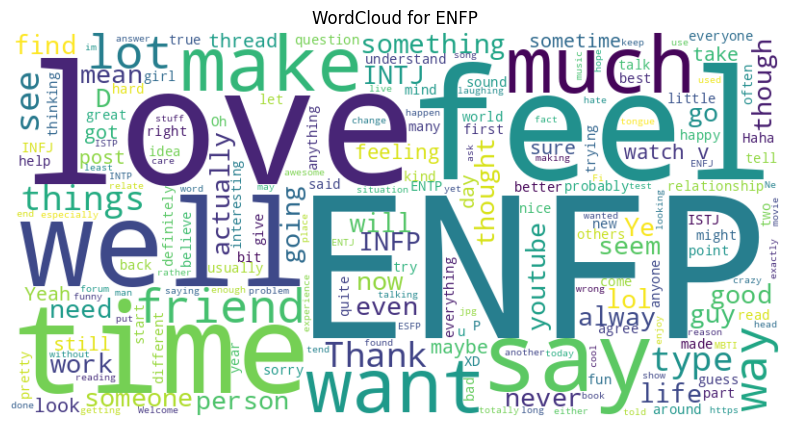
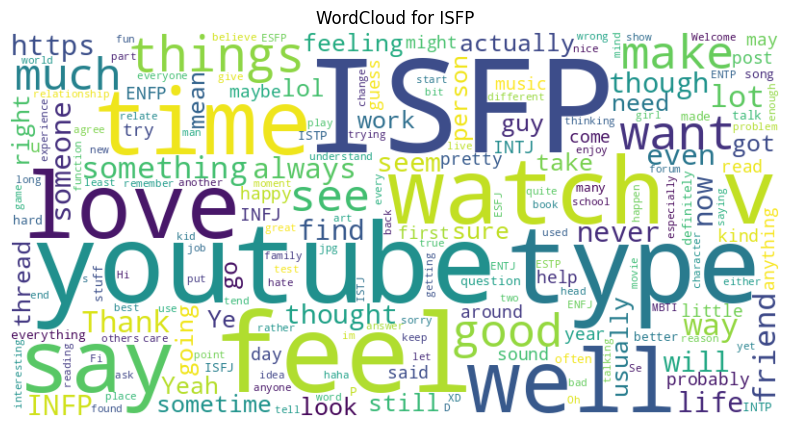
We can even use this model to predict the main personality types!
def predict_personality(text):

    # 1. vectorize input text (same vectorizer as training)
    text_vec = vectorizer.transform([text]).toarray()

    # 2. predict encoded label
    pred_encoded = model_multinomial_nb.predict(text_vec)[0]

    # 3. convert back to original label
    pred_label = target_encoder.inverse_transform([pred_encoded])[0]

    return pred_label
# written by an INTP
sample_text = "Painting the world with the colors of my soul. Interpret it as you like - helping others by volunteering, teaching, giving everything you have. Personal growth - learning as much about the universe...|||6 months ago I met this ENTP guy at my university. We are in the same group, so we basically have to be together everyday, and most likely have to study together for the next 6 years. So cutting off...|||1984 all the way|||I don't like people in groups because it's harder to enslave them.|||ESxJ or ISxJ, because I've noticed that ISxJs don't have much trouble with small talk either. I'd say ISTJ.|||secret :)|||I really like the movie, and Alice is my alter ego in internet, since people find my real name a bit weird.|||Sense of smell easily, because my sense of smell has always been kind of weak. I think it's better that way, because I don't feel and suffer from disgusting smells people seem to feel everyday. I...|||I don't think there's a certain type who would tend to do this. I think it depends on other factors and influences throughout the person's life.|||Honey badgers|||ENFP - creative and challenging conversations. Fun to have both small talk and philosophical rambling. ENTJ/ENFJ - adventurous friend who allows me to see things from different perspective. ENTP -...|||Please, change my username to A Clockwork Alice|||dodartt|||I'd say you're an ENFP, possibly an ESFP too.|||Completely agree with everything OP said. I am cautious around new people and usually hold my true-self inside. Because of that people assume that I am a very calm, shy, possibly even slow and...|||Less planning, more random writing. Let the words flow out of you. Try to write in start and add the characters later. Basically do the opposite of what you've done before and see what happens.|||My native language is Latvian. English is my second language, but I have become fluent enough in that. (At least I hope so). I know a little bit of Russian and German, but I have no further interest...|||Basically I ask myself questions which affect me. Those ordinary existential ones - what is the meaning of my life, what am I, where am I going, what could happen and what couldn't, what changes...|||Blind|||I like learning languages, but I'm too lazy to do it. For now, I'm fluent in English and Latvian, but forcing myself to learn Russian. I really want to learn at least one of Scandinavian languages...|||I was definitely an ENFP. Until society broke me.|||Everyday would be sunny, grass would always be green, all people would be smiling for no reason, everyone would go to church on Sundays etc. All of the earth would be just a big suburb full of sensor...|||1) Once 3) 24 h 4) I like to talk like Yoda. Also Doctor Who quotes. (Let's go poke it with a stick!) 6) I wanted to be a scientist or a writer. Hasn't changed much ever since. 7) Sometimes and I...|||In some way communication is probably one of the things that lead to intelligence. Like, for example, someone asks you a philosophical question. This triggers your mind and urges you to think about...|||Yes, this happens to me all the time. But then again, by telling the truth, you get real friends and get rid of those who can't accept you. I think it's the best way of living there is.|||I'm thinking ENTP.|||Not all of them, I bet there are Sensors who have achieved the same thing with hard work.|||Jumping out from the third floor window and breaking a few bones. I was 10 years old and spent 4 h in pain until my parents came home. That's about it. Now that I think about it, definitely UTI|||I see dead people|||I don't have a system. I just write down important stuff in a chaotic way, so I'm the only person who can make sense out of it later. Also idk what I'd do without photographic memory, but I'm not...|||Love both the books and the series.|||OMG SO FREAKING AWESOME. Thank you!|||The Shawshank redemption.|||I've had a similar problem, only I'm the INTP. For example: A person might have hurt me in the past, and I have forgiven him, but I can't stop living in the past, so I bring back the event...|||Can I have one too? :kitteh: If possible, dark green shield, metallic color - grey.|||Something tells me Gatsby is introverted. All those parties he made and never took part in.|||Happens to me very often. When I get into a new class or just meet new people, in start they don't like me (and they show it), so I just ignore them, but after few months they usually warm up to me...|||No there aren't. There are days when I do everything as scheduled, but then I get bored of it and turn back to my normal self.|||Not knowing the answers to everything - yet.|||If I don't know a person very well I'm too busy with the social interaction and I'm not comfortable with expressing my humor, because the person probably wouldn't understand it. Like once I made a...|||Yes, but mostly with people I've known for years. I think it has definitely something to do with Ne. Sometimes I annoy people because I can already tell what they're going to say by their face...|||Procrastinating, trolling people and acting like it wasn't me, reading/watching something. Thinking up weird case scenarios, like when driving by bus I imagine how it would crash and people would...|||People have labeled me as ''socially retarded'', ''introverted freak'' - I'm not very communicative, so I'm comfortable with the labels unless people start to link ''introvert'' with ''ignorant'' -...|||I'm thinking ISFP or ISTP.|||Welcome to the forum! :kitteh:|||Biggest cliché of them all probably is the never-ending fight between good and evil - good always wins. A socially awkward/miserable guy turns into biggest hero of them all and in the end...|||Welcome, fellow ENFP! :kitteh:|||My guess would be ISTJ/ISFJ, somehow I don't see anything from INTJ.|||My Ni-Te is almost as strong as Ti-Ne, so I've had similar problems. Also close people think I'm extroverted, while others think I'm introverted. I sense a lot of Ni, so you might be INTJ/INFJ, but...|||Both, but lately more adapting, because I like a good challenge"
print(predict_personality(sample_text))INFP